
PASSIVHAUS
As a Certified Passivhaus Designer accredited through the Passive House Institute, I bring specialist expertise in high-performance building design that delivers exceptional energy efficiency, year-round comfort, healthier indoor air quality and long-term durability. This internationally recognised qualification reflects my advanced knowledge in building science and performance-driven design, allowing me to approach every project with a strong focus on practical, measurable and lasting outcomes.
What is a Passive House?
Passive House or ‘Passivhaus’ is a performance-based building standard originally developed in Germany in the early 1990s, embraced now globally, focusing on delivering buildings with:
- Extremely low energy demand
- High levels of thermal comfort
- Excellent indoor air quality
- Measurable, verifiable performance
Passivhaus buildings are designed with exceptionally high levels of insulation and airtightness, allowing them to maintain comfortable indoor temperatures year-round without relying on conventional heating and cooling systems.
Passivhaus is a performance standard that can be applied to both contemporary and traditional home designs, using either innovative building systems or conventional construction materials, with standard building methods carefully refined to achieve higher levels of performance. The standard is equally suitable for new homes and renovations, and is adaptable to a wide range of climates, from cool and temperate regions through to hot and tropical environments.
Key Elements of a Passivhaus:
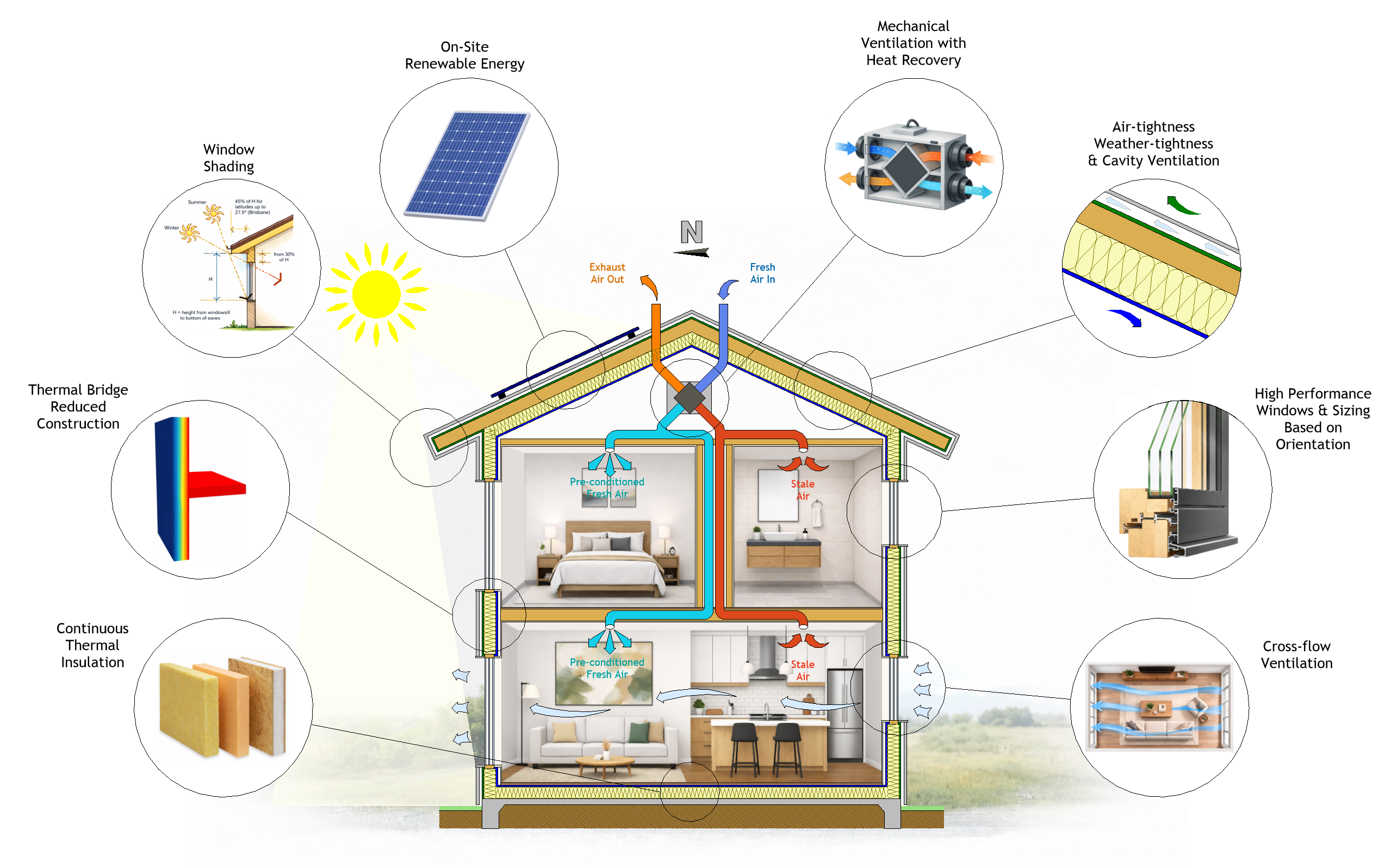
What defines a Passivhaus:
The key performance targets for a Passivhaus building include:
- Heating demand: ≤ 15 kWh/m²·year
- Cooling demand: ≤ 15 kWh/m²·year (climate dependent)
- Primary energy use: ≤ 60 kWh/m²·year
- Airtightness: ≤ 0.6 air changes per hour @ 50 Pa (confirmed via a blower door test.)
The Core Design Principles for a Passivhaus are:
- Super insulated building envelope: Continuous high-performance insulation to minimise heat flow.
- Airtight construction: A continuous air barrier layer to prevent uncontrolled air infiltration.
- High-performance windows and doors: Typically double or triple glazed, thermally broken frames.
- Thermal bridge–free detailing: Careful junction design to eliminate heat loss points.
- Mechanical ventilation with heat recovery (MVHR): Continuous fresh air supply with high heat recovery efficiency.
The benefits of Passivhaus buildings are:
- Exceptional Energy Efficiency: Significantly lowers or eliminates reliance on active heating/cooling.
- Superior Comfort: Constant, comfortable temperatures with no draughts or cold spots.
- Better Health: Constant fresh air reduces allergens, mould, and humidity.
- Quiet Environment: High-performance building envelope reduces external noise.
Why Build a Passivhaus:
Passivhaus FAQs:
Though not required, it is recommended that a certified Passivhaus Tradesperson is engaged to construct a Passivhaus building, as they have the specialist training and an in-depth understanding of the high standards they are working to.
Mechanical Ventilation with Heat Recovery or MVHR is a system that provides the building with continual fresh filtered air.
The stale air stream is passed through a heat exchanger, transferring its heat (or coolth) to the incoming fresh air stream so that energy loss is minimised.
In a Passivhaus building, 30m3 of filtered fresh air is continually provided every hour, for every person.
For building code compliance, the National Construction Code (NCC) sets minimum energy efficiency requirements that need to be met using a NatHERS star-rating system (0–10 stars) based on thermal performance. Many certified Australian Passivhaus homes exceed 8–9 NatHERS stars, but the methodologies are fundamentally different, so they are not directly comparable.
Yes, the analysis software uses climate data specific to the region you are building in to ensure accurate weather modelling and relevant energy use results. Thousands of Passivhaus buildings of all types have been built across the world in all types of climates from Tropical to Arctic, all with outstanding energy savings and comfort levels.
It’s very quiet inside and the temperature is comfortable and consistent everywhere, all the time! There are no draughts, and no noisy air conditioning or heating systems running or blowing air around. The air quality is amazing, with filtered fresh air supplied continuously, and the air tightness ensures bugs and dust aren’t able to get in.
Not at all, the mechanical system will ensure 30m3 of filtered fresh air is continually provided every hour, for every person in the building, and in the very unlikely event the system stops working for a time, you can rely on opening windows and doors just like a typical building.
It is probably truer to say it is unhealthy to be in a leaky draughty building where the temperature fluctuates and the lack of air-tightness results in uncontrolled air flows both in and out of the building which can leave parts of the building under supplied with quality tempered fresh air, creates an increased mould risk, and lets pollutants and dust in.
Absolutely, but you don’t have to rely on this to bring in fresh air – especially when the weather isn’t favourable – as the energy efficient mechanical system will provide filtered, fresh, and tempered air continuously.
Yes, standard construction materials can be used, and you can build on a concrete slab or suspended timber framed floor. Often typical construction methods are simply refined and improved to bring them up to a higher performance level, and sometimes traditional materials and building methods are enhanced with new technologies to substantially improve performance without a great deal more effort to construct.
No, you can have practically any style building you like from Traditional to Contemporary!
Not necessarily – if you are using a high-quality bespoke home, designed above the bare minimum energy efficiency compliance standards as a fair comparison.
Some studies have shown a 5-10% premium while others have shown a minimal cost difference.
Some high-quality components aren’t as easy to source here as they are in Europe or America, and can cost slightly more, but more suppliers of higher performing products and importers of Passivhaus certified components are now emerging in Australia which has helped to minimise additional costs.
Additional costs can also be mitigated with smarter design responses, such as increasing insulation levels or reducing glazing levels to a point that cooling systems become redundant or substantially reduced in size and cost, or by reducing the overall building footprint to reduced construction costs to offset any premium.
Consideration should also be given to prioritising what is important; higher performance windows that will last the life of the building and provide continual measurable comfort improvements, or premium finishes or fixtures that may date or even be replaced when trends change?
With increasing energy prices, the payback period for any additional expense to build to a higher, more energy efficient standard will be paid back sooner too!
No, although some principles are common to both design methodologies.
Passive Solar Design largely relies on an optimised solar design and cross-ventilation from openings around the building to create a comfortable indoor environment. Thermal mass is also used to regulate and even out temperature swings by absorbing heat during hot periods and releasing the stored energy during cold periods. Occupants typically need to actively operate the building to regulate temperatures and air flows, shading thermal mass in summer and strategically opening windows to suit prevailing breezes.
The Passivhaus standard is far more flexible.
While the Passivhaus standard encourages optimised solar design, it isn’t reliant on it and a Passivhaus building can be better suited to sites where solar access isn’t optimal or where views lines aren’t orientated favourably but the outlook still should be captured.
The Passivhaus standard is better suited to locations where noise, pollution, security, or climate extremes are considerations, as indoor air quality isn’t reliant on occupants regularly opening windows and doors – regardless of the outside conditions – to bring fresh air into the building.
Thermal mass isn’t necessary for Passivhaus design either, with light weight construction suitable for some regions and climates.
Airtightness, air quality, condensation risk and mould growth risk aren’t typically analysed when adopting the Passive Solar Design methodology, whereas the Passivhaus standard requires these matters to be rigorously analysed, quantified, and tested to ensure an optimal outcome.